


Context & Scale
Scenario-based learning is useful in various contexts, including professional training in fields like medicine, law, and business, where realistic scenarios help students practice decision-making and problem-solving skills. In business education, this pedagogical approach helps students practice decision-making and problem-solving skills such as managing a crisis, developing a marketing strategy, or navigating complex ethical dilemmas. Scenario-based learning allows students to apply theoretical concepts in practical contexts, improving their understanding and retention. It also prepares students for real-world challenges they may face in their professional careers, making their education more relevant and impactful.
In scenario-based learning, students are often provided with a range of choices to explore. This makes it difficult to implement for large classes that primarily require in-person attendance, due to the complexity of implementation and class time required. In blended learning courses however, a simple scenario-based learning approach supports teaching and learning at scale by utilising digital platforms and interactive simulations, allowing large numbers of students to engage independently. Automated feedback provides personalised responses, while collaborative tools enable group work and discussions. Scenarios can be easily adapted to different contexts, and learning analytics help track progress and identify areas needing support. Instructor facilitation and breakout groups further enhance scalability and engagement.
Scenario-based learning (SBL) is an effective pedagogical approach that can enhance student engagement, knowledge retention, and practical skill application. By immersing learners in realistic scenarios, SBL fosters active participation and critical thinking, enabling students to apply theoretical knowledge to real-world situations. SBL facilitates improvement of decision-making and problem-solving skills, as illustrated by Callanan and Perri (2006) in conflict management scenarios where learners develop appropriate response strategies.
SBL significantly boosts student interest and academic achievement by creating engaging and contextually rich learning environments. Research shows that students in SBL settings not only perform better academically but also exhibit higher levels of engagement compared to traditional learning environments (Shih & Schrader, 2004; Aslan, 2019). This heightened engagement promotes better knowledge retention and deeper understanding of the subject matter. Studies demonstrate that SBL activities, especially when combined with expert feedback and reflection opportunities, significantly improve cognitive readiness and self-efficacy among students (Bardach et al., 2021; Klassen et al., 2021).
By integrating realistic scenarios, feedback, and reflection, SBL provides an immersive learning experience that equips students with essential skills and confidence for success in their academic and professional endeavours.
Problem
Students can understand and recall theoretical knowledge, but they often struggle to apply this knowledge in practical, often complex, scenarios. This is particularly an issue in fields that require the translation of abstract concepts into real-world skills. Concepts learned passively are often quickly forgotten, especially when students do not have the opportunity to apply them. Students might perform well in academic settings and assessments but fail to transfer those skills to real-world situations where variables are less predictable.
Solution
Scenario-based learning (SBL) engages students actively, requiring them to make decisions, solve problems, and reflect on their actions within realistic contexts. By using scenarios that mimic real-world challenges, SBL makes abstract concepts tangible and relevant, and provides students with experiences they can reflect on and discuss. The discussion and reflection can be done online using digital tools, or once the students engage with the scenario online the discussion and reflection can be postponed for in-person lectures and tutorials.
Implementation
Define Learning Objectives: Clearly outline the specific knowledge, skills, and attitudes you want students to gain from the scenario-based learning.
Identify Scenarios: Determine the scenarios that will be most relevant and engaging for your students. Consider real-world situations that align with the learning objectives.
Create Scenarios: Develop detailed scenarios that include background information, a description of the situation, and the tasks or challenges students must address.
Design Supporting Materials: Create any additional materials needed to support the scenarios, such as readings, videos, or case studies.
Define the Decision Point: Clearly define the decision or problem that students will need to address. Ensure that it aligns with the learning objectives of the activity.
Create Alternatives: Develop multiple alternatives or courses of action that students can consider. Ensure that each alternative has its own set of pros and cons.
Feedback on the Decision: Decide on when to provide feedback on students’ decisions. 1) Use online tools to provide immediate feedback on student decisions, or 2) provide feedback on students’ decisions in class. Help students understand the potential consequences of each alternative.
Discussion: Encourage students to discuss their ideas and perspectives with peers. This can help them consider different viewpoints and refine their thinking.
Examples of pattern in use
Exploring Payout Policy in a Finance Course
This pattern was implemented in one semester of an undergraduate Finance subject, FINC2012: Corporate Finance II. There were over 500 students enrolled in the subject.
We would like to acknowledge the subject coordinator, Craig Mellare who co-developed the intervention.
This subject covers fundamental concepts in corporate finance, investment, and risk management, discussing current theories and their real-world application in corporate investment and capital budgeting.
The subject includes weekly live lectures and in-person tutorials. Canvas LMS was used for communicating important information about the subject including what the subject was about, the details and contact method and hours for the teaching team, the course learning outcomes, the required readings for each week, and the lecture slides and recordings. In addition, small activities were incorporated in some weeks, such as the scenario-based learning activity discussed here.
We co-designed the scenario-based activities to a scenario description that was supplied by the subject coordinator. The scenario-based activity was implemented in Week 11 of the semester in a module about payout policy.
Scenario description:
In this scenario, a vacancy has arisen for the chair of the firm’s Remuneration Committee due to the recent resignation of a prominent independent director. The CEO is proposing to assume this role, which involves overseeing the setting of salaries and other forms of compensation for the company’s executives. Another candidate, a newly appointed independent director with prior management consulting experience, is also interested in the position.
The scenario required students to assume one of the five roles: the role of the CEO, Independent board director, Institutional shareholder, Retail shareholder, and Creditor.
The scenario was presented to the students in a video where the subject coordinator described the scenario and explained how the activity worked. We designed an interactive diagram (see the Genial.ly below) to help students explore each of the five roles and their responsibilities. This interactive diagram was embedded on a Canvas page.
Students were then asked to assume one of the roles and respond to the following question:
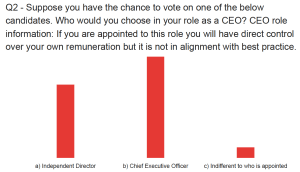
Suppose you have the chance to vote on one of these candidates. Who would you choose in your role?
a) Independent Director
b) Chief Executive Officer
c) Indifferent to who is appointed
Once the students selected a role, they were then asked which candidate they would vote for in their role, see Figure 1 below. These questions were presented to students through a Qualtrics survey. The reason for choosing a survey platform was to aggregate the results, which would then be presented to students in the Week 12 lecture to help them reflect on and discuss their decisions and the consequences with their peers. See for example Figure 1.
Leave a Reply