


Context & Scale
This pattern is concerned with the crucial task of assisting academic staff in acquiring the necessary skills and support to succeed in terms of course design and delivery (Kelly et al., 2024). It addresses the challenge of enhancing mutliple subjects simultaneously by developing a program that helps identify and facilitate co-design activities at scale when working with numerous academics and reaches a broad cross-section of subjects across the faculty.
The Light touch program is a targeted initiative designed to provide timely and short-term support before the semester starts, ensuring academic staff have the resources and support they need. It caters to the diverse development needs of staff, and focuses on subject coordinators and teaching teams who seek to implement minor, yet impactful, changes in subject designs. This approach, central to the program, supports the scaling of quality improvements across the faculty or institution by facilitating tailored interventions that respond to the unique challenges of improving course design and delivery at scale.
Problem
A fundamental problem in educational development is that it often takes place in silos. Academics typically work alone (Wennerberg & McGrath, 2022) and may have a difficult experience implementing changes to their pedagogical approaches, content within their Learning Management System (LMS) or assessments. Additionally, those changes are frequently made under pressure in the few weeks before the semester starts. This challenge can be amplified by other factors such as late staffing decisions, changes in institutional policy and fluctuations in enrolment numbers.
Significant change to unit design is sometimes resisted by unit coordinators due to challenges associated with time, work and institutional constraints, as well as limited experience with assessment design and using educational technology.
COVID-19 exacerbated the need for significant change to units in a short space of time to match new educational needs. Before Covid-19, many subjects in face-to-face-oriented universities operated in comparatively homogenous ways with limited support material for students housed on the LMS. The new educational context challenged these norms and pedagogical expectations. This environment required tailored support where subject coordinators faced problems which needed creative solutions to be tailored to their unique disciplinary needs, particularly given the wide variety of disciplines in the faculty. Emerging challenges such as effectively integrating GenAI into assessment are likely to necessitate an ongoing and flexible approach to support for teaching staff.
Solution
The Light touch program is designed to address the needs and challenges faced by subject coordinators and teaching teams. Implemented over 6-9 weeks, the program offers timely and tailored solutions through a comprehensive package, which includes one-on-one consultations, practical workshops and a range of educational interventions (Wardak, Zeivots & Cram, 2021). The program is timed to provide support to academic staff before the start of the semester. The necessary support may include pedagogical advice, capacity building, educational design and technology-related solutions.
Delivered through a co-design approach (Wardak, Wilson, & Zeivots, 2024), the program delivers solutions tailored to the unique needs of educators and draws upon the expertise of professionals, e.g., educational developers, learning designers, educational technologists and media specialists. These multidisciplinary contributions enrich the design process and ensure that the interventions are holistic and aligned with good practice in subject design.
The Light touch program, whilst being the shortest among the programs offered, provides rapid, flexible support tailored to the needs of academics. For example, the development of adaptable Canvas templates, which easily integrate into the LMS and enhance their look and usability, has facilitated the rapid transformation of subjects. Over time, as academics have observed the enhancements of their peers’ sites and the resulting increase in student ratings, their motivation to participate in the program has grown, and their resistance to change has decreased. We refer to this as ‘proof of concept’ (Bryant, 2021), which demonstrates the effectiveness of the transformation upfront and results in ‘fewer faculty members [that] are left in opposition to the program because they have seen beforehand it is effective’ (Bryant, 2021).
Central to the program’s effectiveness is the role of the educational developers, who lead the Light touch program’s projects and consult with subject coordinators. The co-design process aims to identify priorities, agree on and implement action plans, and evaluate interventions. Preferably, the program is implemented with different units being developed in each round. For example, we run a Light touch program at least once a year to cater to changing unit design and pedagogical needs. This approach results in continuous and tailored educational innovation.
Implementation
Seek expressions of interest from academics to participate in the program. The EOI form can be general in nature, or tailored to specific areas of educational development such as assessment.
Identify which proposals meet the criteria of the program and the type of support needed for each subject e.g. educational development, learning design and/or media support. Consider holding joint workshops for subject coordinators where there are synergies between the areas being developed.
Hold an initial meeting to scope the design work for each subject, and schedule a series of meetings and/or design and development workshops.
Hold regular meetings with the educational development team involved in the program to discuss progress and challenges.
Evaluate the program via a short survey to assess the success of the program and identify opportunities for improvement.
Examples of pattern in use
Example 1: Consistency in the online environment using templates
Students studying multiple subjects in a semester can be confused by the different online subject sites they encounter. The cognitive load can be reduced by creating some consistency between subjects of the home page, welcome module and weekly template structure.
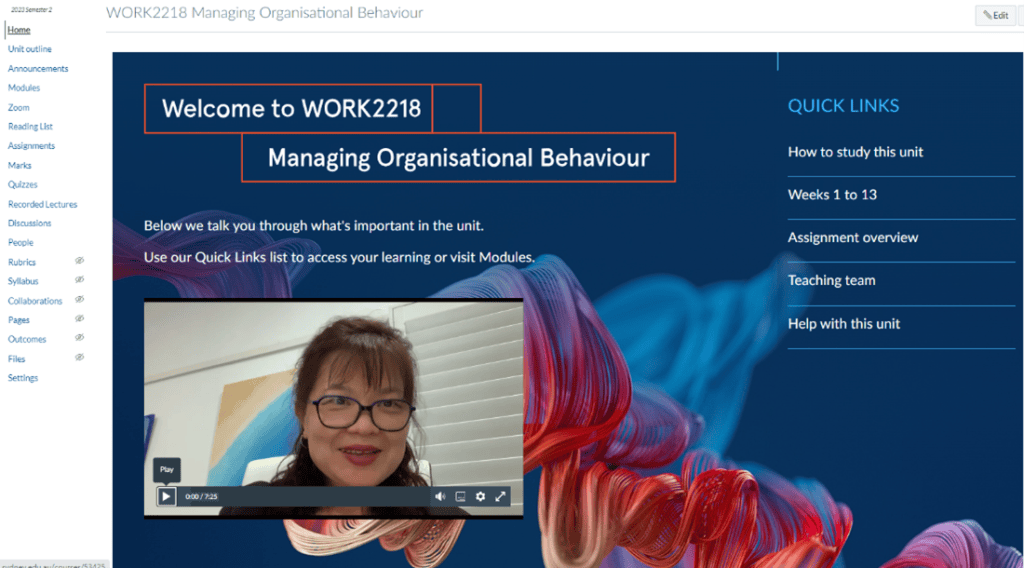
The Welcome Module used in the Light touch program consists of a home page featuring a short video from the unit coordinator introducing the unit and links to other key pages including:
- How to study this unit
- Assignment Overview
- Teaching Team
- Help with this unit
A weekly module template is then tailored to the unit based on the subject coordinator’s needs and requirements. In this case the coordinator wanted a simple three page LMS (Canvas) structure for each weekly module with:
- Overview
- Learn
- Tutorial
This pattern was introduced and implemented in multiple subjects, including WORK2218 Managing Organisational Behaviour. This is a second-year undergraduate subject with approximately 110 students each semester. The majority of these students are international.
We would like to acknowledge the unit coordinator Ju Li Ng and wider teaching team involved from the unit.
Image: WORK2218 undergraduate template for WORK2218 Managing Organisational Behaviour
Example 2: Unit journey maps
Students often have trouble navigating the content in a subject. It is difficult for them to understand how the whole subject fits together. Subject journey maps are an effective strategy to visually summarise the subject structure, showing how each stage of the fits into the whole journey. The “maps” are interactive, with detailed information on each stage revealed when that stage is clicked on. They can be featured on a key page or repeated at the start of each week’s module to signpost where the student has progressed in the subject and what comes next.
Image: Journey map for IBUS3101 International Business Alliances
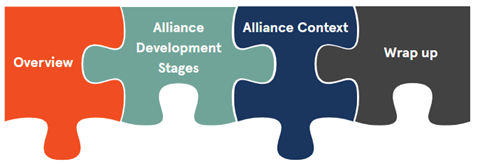
This map was introduced and implemented in IBUS3101 International Business Alliances at part of the Light touch program. This is a smaller third year undergraduate unit with approximately 50 students each semester. The cohort consists of 50% domestic and 50% international students. The coordinator wanted a jigsaw type visual showing how his unit’s four stages fit together.
We would like to acknowledge the unit coordinator Anish Purkayastha and the wider teaching team involved from IBUS3101.
Leave a Reply