


Context & Scale
The One-Minute Paper (OMP) at scale pattern involves the collection and analysis of anonymous student feedback on their learning experience and the formulation of changes to immediately transform the student experience. This pattern can be used in any large course where the course coordinator believes the teaching approach or learning activities could be improved in some way. The OMP as a classroom assessment technique is not new. It was popularised in the 90s by Angelo and Cross (1993), who argue that the benefits of the OMP for both students and teachers are sizeable for a modest investment of time and effort. Though the OMP has historically been employed in small class settings the pattern described here is aimed at large courses with multiple tutors overseen by a course coordinator.
Problem
The OMP addresses several educational problems. Acting on feedback from students to improve their learning experience, especially at scale, is a challenge. We normally only ask for feedback from students about their learning experience at the end of a course in a survey, which typically has a low response rate. So, any course changes made to improve the learning experience will only benefit the students who follow, not the students who delivered the feedback.
Secondly, as students transition from secondary to tertiary education, they need to become competent independent learners. The OMP encourages students to think about their learning, to think at a metacognitive level, a capacity that will help them to devise better study habits (Tanner, 2012) and become better self-regulated learners, which has been linked to academic achievement (Schunk & Zimmerman, 2008).
Thirdly, promoting engagement on campus in the post-COVID era is more challenging than ever as students have become accustomed to studying at home and having to juggle the demands of study and work. The OMP can promote engagement in the classroom by adding value to the on-campus experience. The OMP is a strategy that can transform a common passive learning experience for students into an active one. By giving the student the opportunity to provide feedback to the teacher, this dynamic is reversed, engaging the student in the teaching and learning process in a visible and concrete way and opening up a “door of communication that may otherwise be shut” (Harwood, 1996, p. 230).
Solution
The OMP involves taking around one minute at the end of class to pose one or two questions to students which they answer anonymously, such as:
- “What challenges do you expect in this course?” (first class)
- “What was the most important thing you learned today/over the last X weeks?”
- “What do you want more of in class?”
- “What do you want me to change in class?”
- “What do you need help with?”
The teacher then reads the responses and decides what changes will be done in response to the feedback. The teacher begins the next class by presenting a summary of the feedback and explaining what changes will be made based on the student feedback.
Benefits of the OMP
Students view OMPs positively when they have been used sparingly and intentionally. OMPs have been found to improve the learning experience/environment through a consistent platform for sharing feedback (Campbell et al., 2019) and deliver considerable benefits at little cost (Stead, 2005). By offering students multiple means of expression, the OMP aligns to the second Universal Design for Learning principle (Hall et al., 2012) as it gives a voice to every student, even those who might be shy or hesitant to speak up in class (Levin-Banchik, 2022). This contributes to building an inclusive learning environment.
Scaling up the OMP for large courses
The OMP was originally implemented in smaller classes with students using pen and paper to write their responses, and teachers reading through the responses and deciding what changes will be made. This approach is unviable in large courses with multiple tutors collecting feedback from hundreds of students. This pattern adopts a digital approach for both data collection and analysis to make best use of tutor time and keep costs down.
Tips
- It is key that something happens with the feedback: If the next class begins and there is no reference to the responses gathered the week before, and no actions arising from that feedback, there will be no benefit to either student or teacher and students will quickly disengage.
- Early implementation: Use OMPs early in the teaching period to establish communication norms and set classroom tone.
- Keep It fresh: Change the questions to maintain student interest and engagement.
- Keep it unpredictable: Students will lose interest if they have to do an OMP for each session. Pick key weeks to ask students for feedback (3-4 times).
Implementation
Pre-course – 5 weeks before teaching begins: Course coordinator decides which questions will be asked and the weeks the OMP will be implemented (we recommend week 1 and three other weeks at key points in the teaching period) and the technologies to be used to assist in the data collection and analysis.
3 weeks before teaching begins: Course coordinator briefs tutors on the OMP and its implementation and method for data collection and analysis and organises training for tutors who require it.
In class: Tutors explain rationale for implementing the OMP to students and implements first OMP at end of session using a digital feedback collection tool (e.g. Mentimeter, Padlet, Qualtrics, etc)
Post class: Immediately after class, tutors take 30 minutes to conduct a thematic analysis of student responses and write a 150-word report with accompanying recommendations, which is then sent to the course coordinator. An AI tool such as ChatGPT, Gemini or Claude should be used in this process to keep the time down to 30 minutes.
The course coordinator reviews the reports and creates a meta summary of the reports and determines what immediate actions will be taken to improve the student experience, which is then sent back to the tutors.
Next class: The tutors begin the next class with a presentation of the responses, at both a local and global level, outlining what changes will be made in response to the feedback.
Examples of pattern in use
The One-Minute Paper in IBUS1102 Cross Cultural Management
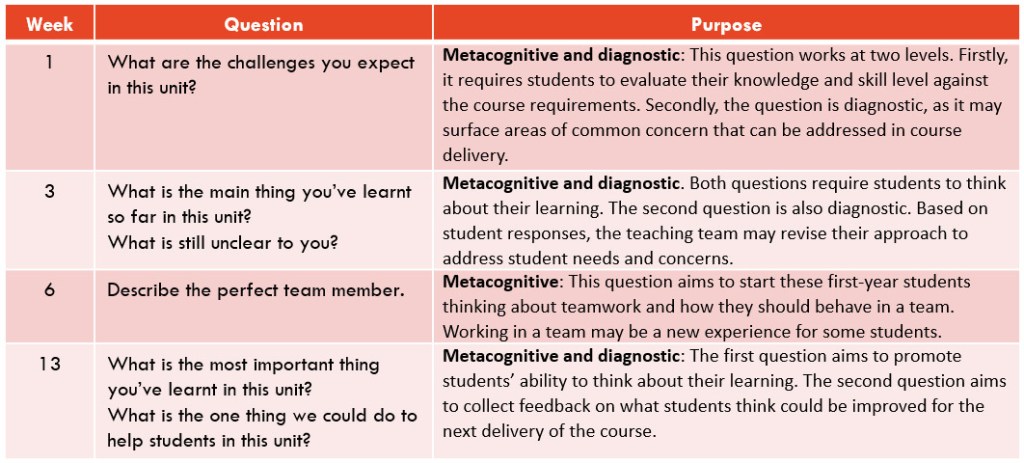
An OMP approach to collecting anonymous student feedback was implemented in the first-year course IBUS1102 Cross Cultural Management in Semester 2, 2024. This course attracts enrolments of over 150 students and for the inaugural implementation of the OMP, the course coordinator was working with a team of four tutors. The course coordinator and educational developer met for about one hour to decide what questions should be asked and what weeks they would be implemented in. In this meeting it became apparent that each question served a different purpose, which aligned to either an assessment task or a learning activity that students were engaged in at that point in the teaching period. See table below.
Week, questions and purpose of OMPs in IBUS1102
Student feedback-tutor-course coordinator workflow
Tutors used Mentimeter Open Ended question to collect student feedback at the end of class which was downloaded as a spreadsheet. Casual tutors were paid an extra 30 minutes to generate a feedback report and some suggested changes. First, tutors eyeballed the responses in the spreadsheet to get a sense of the feedback and identify any obvious themes. Then, with the assistance of a ChatGPT agent expert in thematic analysis, they refined the analysis into a final 150-word report with suggestions, which was sent to the course coordinator for further analysis. The course coordinator created a meta-summary of the student feedback and decided on what changes would be made in the classes. This meta-summary was sent back to the tutors, who began the next class with a presentation of the feedback and the actions that will be taken to improve the learning experience.
Leave a Reply